FCA AI Good Practice: What It Means for Communications Compliance
The FCA's October 2026 AI good practice findings are written for AI in general, but they say a lot about the AI now built into how firms record, transcribe and review conversations.

On this page
- What the FCA published
- Treating AI outputs as the record turns review into box ticking
- Transcription and analysis go wrong in different ways
- Keep a record of how each review went
- How the FCA's themes apply to recorded communications
- What I would ask any recording vendor
- Where Argus Archive fits
- Oversight starts with the conversation
- Frequently asked questions
- References
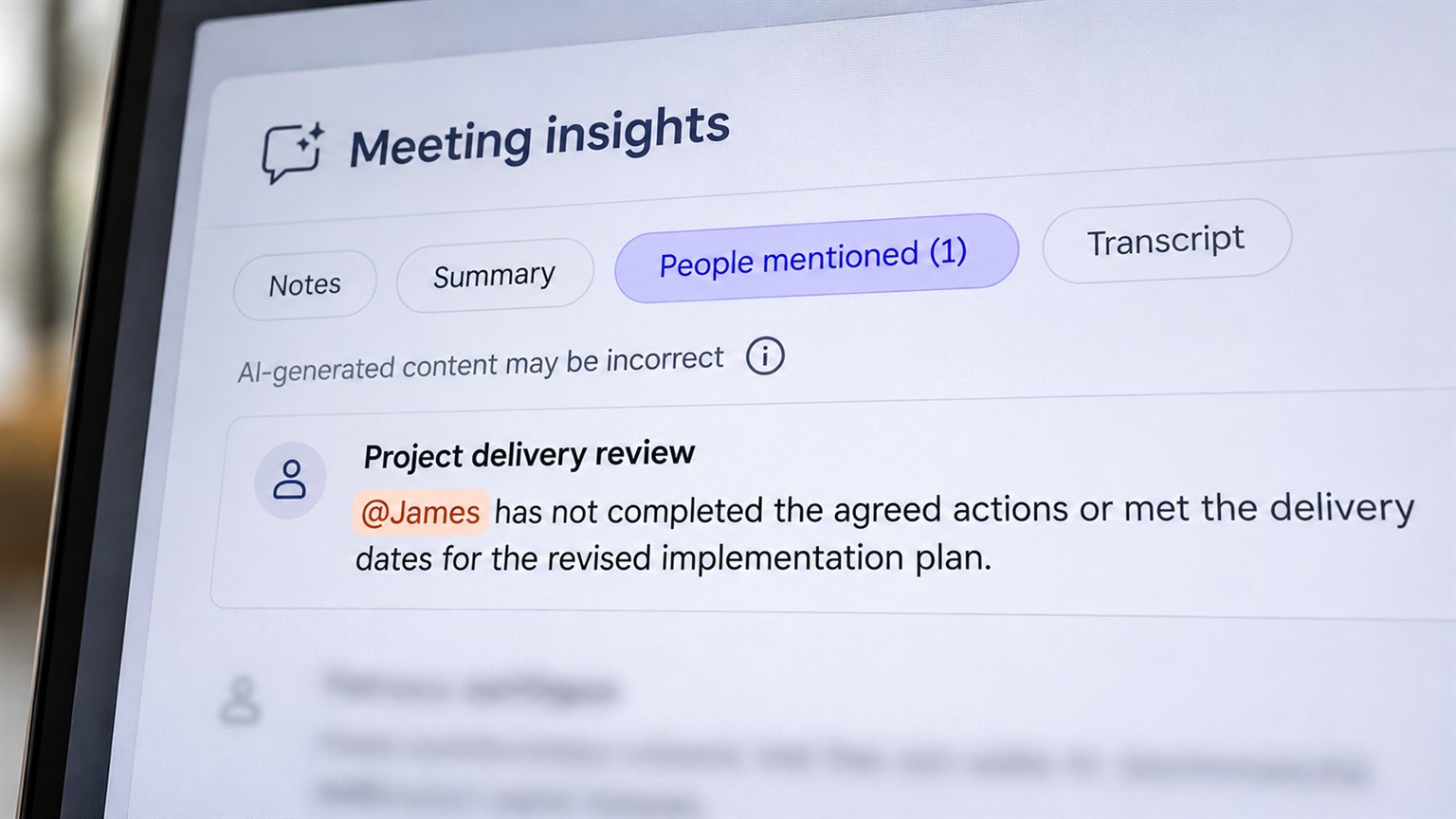
Last week, I heard about an AI meeting recap that tagged the wrong person for missing deadlines. The transcription had misheard a company's name as his first name, and because he had been invited to the meeting but could not attend, the recap tagged him instead.
He found out from a notification, and checked to find he was being blamed for deliverables he had never been asked to do. He tried to listen back to the call, but no audio recording was available. After messaging a few of the people who were there, he worked out that the tag was wrong. There was no way to edit it, so his name stayed in the meeting record.
Had that recap reached senior leaders without context, it would have read as a record of him failing to deliver, and with no recording he would have had no way to prove otherwise.
It's a familiar story. A transcript mishears a name, a company or a product and swaps it for something more common. No AI model will be right every time, so the question is whether you can show what really happened when it was wrong.
For conversations, that comes down to three records: the recording itself, what the AI was tested on before it went live, and who reviewed its output and what they decided. The FCA keeps coming back to the same problem in its latest publication on AI: people relying on AI output need to be able to check it, and that check has to be meaningful.
What the FCA published
On 19 October 2026 the FCA published AI in financial services: good practice and areas for improvement 1. It draws on the regulator's supervisory work and its AI Lab, and it sets out examples of what firms did well and where they fell short. The FCA is clear that these examples do not create new requirements. It also lists the Mills Review, which we wrote about in July, among its sources.
Most of the commentary so far has summarised the whole document. In this post I look at one part of it: what the findings mean for the AI that firms now use to capture and understand their conversations.
Treating AI outputs as the record turns review into box ticking
One of the FCA's case studies (case study O) describes a firm where the human reviewer's role was unclear and, in the FCA's words, "became a tick-box exercise over time". Reviewers accepted more and more AI recommendations without real scrutiny, and unclear escalation rules meant some AI outputs went ahead even when the system was unsure.
AI output about conversations can slide into the same habit. A transcript, a set of meeting notes or an alert is far quicker to read than listening back to a call. Over time it becomes tempting to treat that output as the record. It reads well and it is usually right, so nobody checks it until it matters.
The FCA also gives an example of the opposite (case study N). A firm using AI for affordability assessments kept the decisions with its staff while the system was being set up. Reviewers judged each case without seeing what the AI had proposed, so the firm could compare the two and reduce the risk of people simply agreeing with the system.
The FCA calls this automation bias, and it is hard to avoid when an alert is usually the reason someone opens a call. Firms do not have to lean on reviewers alone. They can run their rules against a fixed set of past calls where the right answer is already known. That shows what the AI misses or flags wrongly, and running the same set again after every change shows whether it got better or worse, without anyone relistening to calls.
Transcription and analysis go wrong in different ways
The FCA's good practice includes monitoring AI for drift and harmful outputs, testing before deployment and assessing generative AI output against clear criteria. For communications there are two kinds of AI to think about, and they need checking in different ways.
The first is transcription. A transcription error means the words themselves are wrong. A transcript that mishears a name, a product or a figure carries that mistake into every summary, search and alert built on top of it. No transcription model is 100% accurate, which is why the recording matters, because it is the source any transcript can be checked against. And when a vendor moves to a new transcription model, it should be able to show that the new model was tested on real conversations before it reached yours.
The second is the analysis built on top: summaries, rules and alerts. A transcript can be word perfect and the analysis can still reach the wrong conclusion. A rule might flag too much, miss what it was written for, or behave very differently on real calls than it did on paper. In my view, changes like these should be tested on your own conversations before they go live, and the results kept, so you can show later what was tested and what changed.
Keep a record of how each review went
One of the FCA's examples comes from a smaller firm. It stressed the need to record whether staff needed to review an AI output, whether they did, and whether they approved it, overrode it or escalated it. The FCA explains why that mattered:
"This created an audit trail showing how oversight operated in practice, rather than relying on an assumed control."
For anyone acting on AI output about conversations, the equivalent is a record of what happened next: who looked at it, what they decided and when. A flag that was raised and quietly closed tells you very little, whereas an owner, a status and an escalation history show that the review took place.
How the FCA's themes apply to recorded communications
The table below is my summary of how the FCA's good practice themes apply to recorded communications. It is my own practical reading of the findings, and the FCA has not published it as a checklist.
| FCA theme | What it looks like for recorded communications |
|---|---|
| Human review becoming box ticking | Summaries and flags accepted without anyone checking the conversation |
| Audit trail of review, override and escalation | A record of who reviewed each flag, what they decided and when |
| Monitoring for drift and harmful outputs | Watching transcript accuracy and false alerts over time |
| Testing before deployment | Trying changes on past calls before they go live |
| AI-specific questions for suppliers | Asking recording and archiving vendors how their AI works and changes |
| Exit options and vendor dependence | Being able to take recordings, transcripts and review records to another provider |
What I would ask any recording vendor
The FCA's findings include a firm adding AI-specific questions to its supplier assessments (case study I), and another that had to redesign its product when the model it depended on was retired (case study T). If I were assessing a recording or archiving vendor today, these are the areas I would want clear answers on:
- Models. Which models transcribe and analyse your calls, and where they run.
- Model changes. Whether you are told before a model changes, and what the vendor tested before it did.
- Traceability. Whether every transcript, summary and flag can be traced back to the moment in the recording it came from.
- Testing. Whether changes can be tested on your own past calls before they go live, with the results kept.
- Review records. Whether each reviewer's action is recorded, with who and when.
- Training data. Whether your data is used to train the vendor's models.
- Leaving. Whether you can take your recordings, transcripts and review records with you, or keep them in your own storage from the start.
Where Argus Archive fits
These are the questions we have tried to answer in how Argus Archive is built. Calls and meetings are recorded by policy, on Microsoft Teams today, so the recording is there to go back to. Recordings can be kept in your own Azure storage, and calls and transcripts can be exported or reached through our APIs, so your archive is never locked in with us.
Each alert sits on the call's timeline at the point in the conversation that raised it, so a reviewer can go straight to what was said. It has a status and can be assigned to a reviewer, and we record who escalated or closed it, when, and why. More on how this works for regulated firms is on our financial services page.
AI Assurance covers the analysis. Before a rule change reaches live calls, it can be tested on past calls from your archive and on test conversations the AI drafts for you, and nothing reaches reviewers until it is published. Every version, change note and test run stays on record, with its date and who ran it, ready to show an auditor.
Oversight starts with the conversation
The FCA has not written a rulebook for AI in communications, and I would not read this publication as one. But its examples keep pointing the same way, towards oversight that is planned from the start and leaves a record of what people checked.
For communications compliance, that record has always started with the conversation itself. The story I opened with is a good reminder of why. An AI summary is only as trustworthy as your ability to check it against what was actually said.
Frequently asked questions
Does "AI in financial services: good practice and areas for improvement" create new rules for AI?
No. The FCA describes the examples in its October 2026 publication as illustrative and says they do not create new requirements. But it is also clear that existing rules already apply to firms' use of AI, including the Principles for Businesses, SYSC, the Consumer Duty and the Senior Managers and Certification Regime. Firms are responsible for the AI systems they develop, procure and deploy, including their outputs and outcomes.
Does the FCA require human oversight of AI?
The publication does not set one rule for every firm. It says human oversight should be designed around the use case, how much the AI does on its own and the potential impact on consumers or markets. It also warns against relying too much on human review, because it can hide weaknesses in the model itself.
What does the FCA mean by human-in-the-loop?
The FCA defines it as "a control where a person reviews, approves, challenges or can override an AI output or decision before it is used".
What does the FCA say about audit trails for AI?
Its good practice includes logging and audit trails of AI interactions, and records of prompts, outputs, model versions and escalation decisions. Among its areas for improvement, it found some firms' decisions on AI tools were poorly documented, with limited audit trails.
References
-
FCA: AI in financial services: good practice and areas for improvement: https://www.fca.org.uk/publications/good-poor-practice/ai-financial-services↩
Disclaimer
This article is provided for informational purposes only and does not constitute legal, compliance or governance advice. Firms should consult their own legal, compliance or risk teams for guidance on their specific situation.